AAAS team just visited Atmiya Vidya Mandir School near Surat for sky gazing programme with 8th Std. The students has a complete chapter on Astronomy. It contains very basic and most general topics. So school decided to have sky gazing programme as their regular curriculum apart from their class room study.
AAAS team was invited for the programme. We had wonderful night with the students. We observe and gave information on Sirius, Orion, Mars, Pleiades,Moon, Pole star,Ursa Major,Cassiopiea and discussed plenty of question coming continuously from Extra energetic and interesting students.
We all had wonderful experience and leaned many new things from whole event.
Thanks!

February 21, 2010


February 08, 2010
Lecture by Dr.Rajmal Jain

Dr.Rajmal Jain, a senior professor in Physical Research Laboratory(PRL) recently visited Applied Sciences Deptt.(Now separated into Physics,Chemistry and Mathematics) to deliver lecture under the title " Global Warming; What is the truth? " This was joint effort by AAAS and Society for Cultivation of Sciences and Humanities (SCOSH).
The brief summery of the lecture:
Americas,Europe including many countries which is part of UN frequently says that there is only India and China behind the global temperature rise. Dr. Jain,very beautifully,oppose the saying by giving factual,logical and statistical scientific reasoning.
We all enjoyed a lot.
Thanks Dr. Jain,we hope to see you again.
January 19, 2010
From 11:26am to 2:29pm
An ASEclipse report from Surat.

At 10:29 am on 15th Jan, we were at the college for the final planning and discussion of our educational trip. We had finalised the dates of the tour to be 17th-18th Jan much before. I already missed one chance to see full (100%) ASE and now, I was totally confirmed that this (Partial) is also, certainly, going to be missed. But we got unexpected relief and we were told to come again at 3 pm. Hurreyyy!
I rushed towards home and started finding whatever I could, to capture the phenomenon. Finally, I, with my Camera, Tripod and Solar goggles, went to terrace. The time was ~ 11:15 am. Everybody was enjoying the kites. I placed my camera and immediately decided to put one half of the solar goggles in front of the lens and another in front of my eye. The first contact appeared around 11:26 am and maximum eclipse occurred at 1:20 pm. I was not there up till last contact. My last shot was at 2:29 pm. Then the battery exhausted. There was still half n hr left for the last contact.
It was my first try to capture the Sun. Initially, I was worried for my camera but everything went good. All the people in my building showed great interest. They also attracted the people who initially refused, due to “non-scientific” fear. I also showed them the pinhole projection using very basic thing which we use in kitchen-A GRATER.
All in all it was a fabulous experience. I am quite satisfied with my first solar eclipse and first solar photography.
January 08, 2010
Partial Solar Eclipse: 15/01/2010
Observation Camp of Partial Solar Eclipse from Gandhinagar on 15th January 2010:
Photograph taken by AAAS Team:


December 29, 2009
Lets end/start year with Lunar Eclipse
PARTIAL LUNAR ECLIPSE on 31st Dec.
Fast facts: For Ahmedabad
Date: 31th Dec,2009
Eclipse type: Partial
Penumbral Mag. : 1.056
Umbral Mag. : 0.076
Pen. eclipse begines: 22:47
Par. eclipse begines: 00:23
Mid. eclipse: 00:53
Partial eclipse ends: 1:23
Pen. eclipse ends: 2:58
For complete info. consult this site:
http://eclipse.gsfc.nasa.gov/JLEX/JLEX-AS.html
Fast facts: For Ahmedabad
Date: 31th Dec,2009
Eclipse type: Partial
Penumbral Mag. : 1.056
Umbral Mag. : 0.076
Pen. eclipse begines: 22:47
Par. eclipse begines: 00:23
Mid. eclipse: 00:53
Partial eclipse ends: 1:23
Pen. eclipse ends: 2:58
For complete info. consult this site:
http://eclipse.gsfc.nasa.gov/JLEX/JLEX-AS.html
November 23, 2009
Do You Know ? NEUTRINO
Word "Neutrino" comes from Italian word; It means
"Little Neutral One".It is one the fundamental particles
used in the construction of the universe.It consists the mass which is 10,000 times less than the mass of the electron. They are electrically neutral, and do not interact with the ordinary matter and hence very difficult to detect. There are many sources of neutrino but major part of it which falls on the earth comes from the Sun. There are nearly 50 trillion solar neutrino passes through human body per second.
"Little Neutral One".It is one the fundamental particles
used in the construction of the universe.It consists the mass which is 10,000 times less than the mass of the electron. They are electrically neutral, and do not interact with the ordinary matter and hence very difficult to detect. There are many sources of neutrino but major part of it which falls on the earth comes from the Sun. There are nearly 50 trillion solar neutrino passes through human body per second.
Concern for more interesting details :
1) http://www.ps.uci.edu/~superk/neutrino.html
2) http://en.wikipedia.org/wiki/Neutrino
November 16, 2009
Leonids Meteor Shower 2009

Credit and Copyright: Chris L. Peterson.Taken from www.cloudbait.com/science/leonid2008
This meteor shower has been named as "Leonids Meteor Shower" because it appears to stream from the constellation LEO (Shiha) in the sky. The shower starts from that point where the Siha Rashi/Constellation LEO is situated and streaching of tail can be seen in large part of eastern sky.The earth, right now, is passing through the stream of debris of the comet which is known scientifically as comet 55P/ Tempel Tuttle.This comet was passed through this site nearly 500 years ago in 1466. So the world is waiting to see the truely historical event in every aspect. The peak (numbers of meteors per hour) is espected on 17th November,2009. The day (night!) is the next day of full moon hence we will not have any problem due to the moon light to see the shower.
The peak is expected during 00:00 am to 02:00 am approximatelty.The constellation will rise in India nearly 2:00 am. You can see upto 500 meteors per hour. Find the darkest place.Take chair or lay down on carpet and enjoy the shower from the heaven!!
Accept scientific approch during your observation.
1) Note down the numbers of meteor you see in hour of at a regular duration of time.
2) Note down the characteristics like the brightness( average,normal,highest), the length of the tail you see(small,big,average)
3) Find the Latitude-Longitute of the place from where you are observing or the approximate location. ( at the terrace, near your house,in nearby garden; don't forget to write the address)
4) Or anything you see..
5) Make Sketch, Take pictures , record on movie camera...
For the scientific use the record of Time, Add. of place and date is necessary.
Submite your data to AAAS via mail (aaasteam@gmail.com) or IMO(Intenrational Meteor Organization)(http://www.imo.net/)
For other information mail us. or checkout the following sites
- en.wikipedia.org/wiki/Leonids
- science.nasa.gov
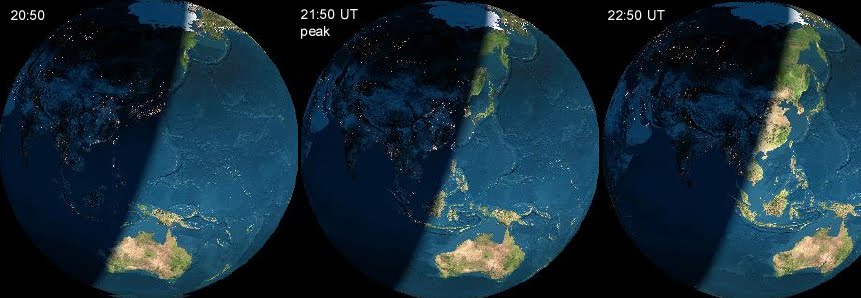
Credit: leonid.arc.nasa.gov (taken from this site)
You can see that Asia,and India as well, is very favourable during its peak time.
November 11, 2009
World Science Day- 10th November 2009 Celebration:
To spread the knowledge of Astronomy, AAAS had delivered a seminar on General Astronomy Guide on 10th November as an occasion of World Science Day at Udhyog Bharti School, Pandesara, Surat.
The strength of students were around 250 from 7th to 12th standards. The principal of the school Mrs. Pannaben Desai gave warm welcome to us. One of the member of AAAS, Nikunj Rawal delivered this speech.
The secretary of Satyashodhak Sabha, Surat, Mr.Sidhharth Degami was also with us to explain wrong superstitions running in society and to remove it by knowing Science by performing many experiments himself.
Udhyog Bharti School, Pandesara, Surat

More than 200 students participated

Mrs.Pannaben Desai, Principal of School

Nikunj Rawal explaining about Astronomy


Mr.Sidhharth Degami, Satya Shodhak Sabha, Surat
October 14, 2009
Nikunj Rawal with Dr.A P J Abdul Kalaam at IIM, Ahmedabad on 12th October 2009 on "Science On Wheel Conference"


One of the AAAS Member Mr. Nikunj Rawal met our honourable former presedent, Dr.A P J Abdul Kalaam at IIM, Ahmedabad on 12th October 2009 on "Science On Wheel Conference".
See above photo- Talking about AAAS Association and his Activities
October 05, 2009
AAAS Affiliates to AWB:
AAAS has affiliated with Astronomers Without Borders- AWB. Please click on below link to go to AWB Site:
http://www.astronomerswithoutborders.org/index.php/component/comprofiler/userprofile/AAAS.html
http://www.astronomerswithoutborders.org/index.php/component/comprofiler/userprofile/AAAS.html
Global Warming- Save Earth Save Environment
AAAS has made their own advertisement on Global Warming.
Send your suggestions on aaas.team@gmail.com
AAAS Captured Sun Images on 28/09/2009:

Beautiful Evening Sun captured by AAAS Team with Nikon S52; D=150mm*1050mm using 16 mm Eyepiece (With Solar Filter)

Evening Sun behind a Tree captured by AAAS Team with Nikon S52; D=150mm*1050mm using 25 mm Eyepiece (Without Solar Filter)

Sun behind Tree captured by AAAS Team with Nikon S52; D=150mm*1050mm using 25 mm Eyepiece (Without Solar Filter)

September 10, 2009
Atmospheric Scene captured by AAAS:
We have captured the atmospheric reflected rays coming out from clouds.
Our photo has been submitted to SpaceWeather.com site.
Please click on below link to see the photo:

September 05, 2009
AstroPhotography by AAAS Team:

12th Moon

Plato Crater on Moon

12th Moon

Jupiter-Moon Conjuction on 2nd September 2009
August 31, 2009
Asrtronomical Meet at Polland, Europe
One of our AAAS Member Mr. Charitarth Vyas is going to attend Astronomy Conference and will be presenting a theme on "Ancient Indian Astronomy" at Polland, Europe between 5-14 September 2009.
Bravo for AAAS!
August 25, 2009
Jupiter at Opposition:
Jupiter and its three Moons, namely, Io, Europa and Callisto as photographed by AAAS Team on 21st August through their 6" Inch Konus Newtonian Reflecting Telescope.


Jupiter and its three Moon, Io, Europa and Callisto (Gynemede was hidden) through 6" Inch Konus Newtonian Reflecting Telescope.

The craters of Earth's Moon through 6" Inch through 6" Inch Konus Newtonian Reflecting Telescope.
August 19, 2009
Jupiter's Moon's Eclipse:
On August 16th, Philippine Astrophotographer Christopher Go used a modern 11-inch Celestron telescope to photograph Jupiter's moon's Io casting its shadow on Ganymede.

August 17, 2009
Jupiter Without Moons:
On 2-3 September 2009, Jupiter will have no moon appearance as seen from Earth.
 The planet Jupiter can usually be seen with all or some of its four largest moons in binoculars and small telescopes.
It is very rare for it to be seen otherwise.
But late on this night in most of the Western Hemisphere, the planet will be visible with no moons for nearly two hours.
 The planet Jupiter can usually be seen with all or some of its four largest moons in binoculars and small telescopes.
It is very rare for it to be seen otherwise.
But late on this night in most of the Western Hemisphere, the planet will be visible with no moons for nearly two hours.
August 11, 2009
Perseids Meteor Shower August 2009:
Perseid Meteor Shower (Ulka-Varsha) on 12-13 August 2009 in North East after Midnight in the constellation Perseus.
You can see more than 60 meteors per hour.


Saturn Without Rings on 10th August 2009:
 Saturn Without Rings (NASA)
Because the angle of Saturn's Rings and Viewing from Earth are same, we cannot see its rings for few months.
Subscribe to:
Posts (Atom)